
The coupling plays a pivotal role in the wind turbine generator system, serving as a small "bridge" between the blades and the generator, and bearing a significant responsibility.
What is a coupling
In simple terms, a coupling is a device that connects two rotating components, ensuring the transmission of force and allowing the generator to operate normally. The wind turbine coupling primarily transfers the rotational kinetic energy of the wind blades to the generator. Without it, the wind would rotate, but electricity could not be generated.
Principle of coupling
When the wind blows, the blades rotate, and the rotational force is transmitted to the generator through the coupling. The generator then converts mechanical energy into electrical energy.
During the operation of the coupling, the transmission of force is crucial. It must withstand the impact force brought by strong winds while maintaining stable operation. This demands high strength and elasticity from the coupling, which must continuously adjust to the pressure brought by strong winds and flexibly respond to various challenges.
The structure of the coupling
The coupling consists of a diaphragm set, a clamping sleeve, a brake disc, an intermediate cylinder assembly, and an internal/external torque limiter. Haikun can provide customized services according to customer needs, as well as failure cause analysis and technical support.
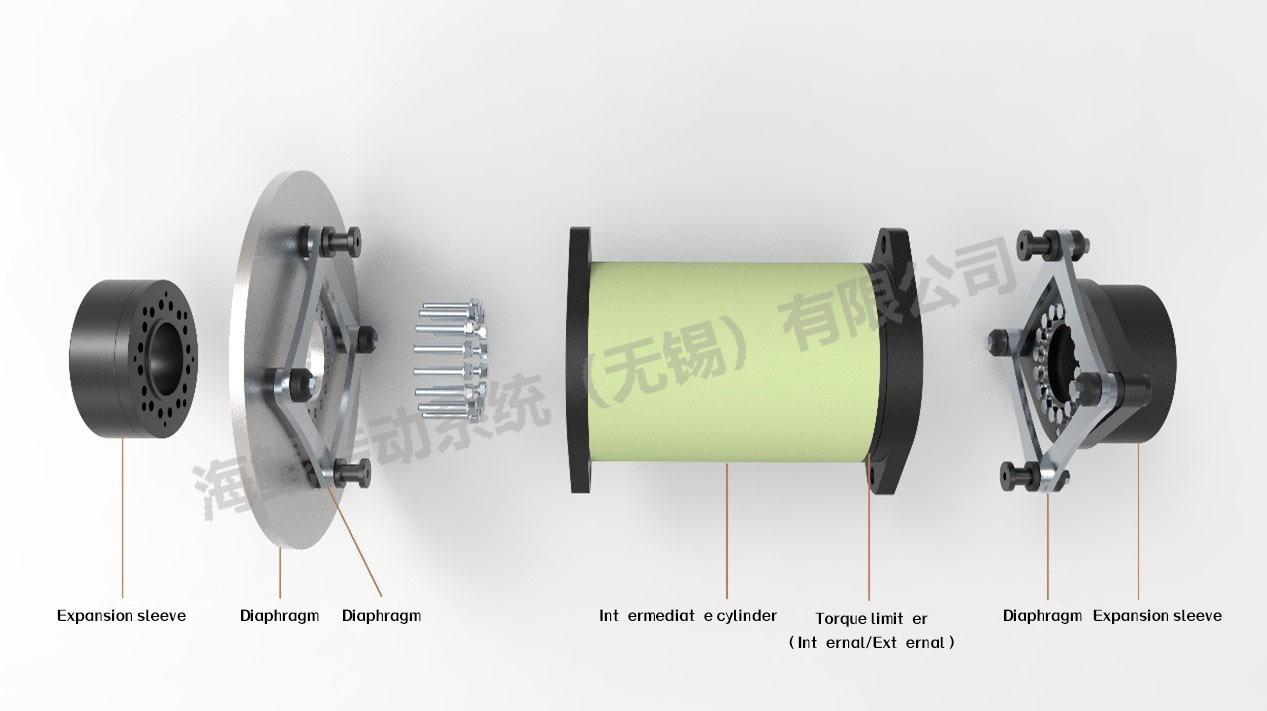
The core advantages of couplings
Design science: Each proposal includes core data such as multi-dimensional simulation calculations and fatigue life assessment, providing theoretical support for reliability;
High durability: The diaphragm assembly, after undergoing a secondary strengthening process and Dacromet anti-corrosion treatment, achieves a corrosion resistance level of C4H, making it suitable for use in harsh environments across multiple scenarios;
Safety and stability: The torque limiter supports built-in/external customization, and is paired with copper-based powder metallurgy friction plates, which are resistant to high temperatures and wear, ensuring no degradation during long-term operation;
Excellent insulation: The intermediate tube assembly adopts a glue storage groove bonding structure, with a resistance value of >200MΩ under DC1000V conditions, meeting high standard insulation requirements.