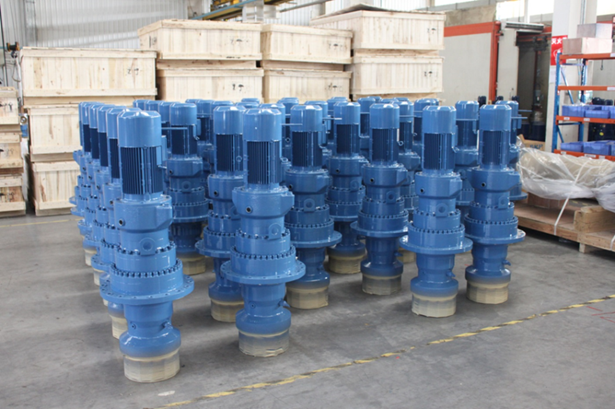
The planetary gear reducers used in the wind power industry achieve power reduction and torque amplification through the complex motion of planetary gear sets. Their core principle is consistent with that of general planetary gear reducers, but they must meet the special requirements of the wind power scenario.
Core structure and transmission principle
The planetary gear reducer is primarily composed of a sun gear, planetary gears, an internal gear ring, and a planet carrier. The sun gear serves as the input end to receive power (such as high-speed rotation of a motor). The planetary gears revolve around the sun gear while rotating themselves, achieving speed reduction and torque amplification through meshing with the internal gear ring. Specialized models for wind power typically utilize carburized and quenched steel (such as 20CrMnTi) to enhance load-bearing capacity, and optimize tooth profile design to reduce operational noise.
Adaptability to wind power scenarios
High load-bearing capacity: The planet carrier is made of ductile iron (such as QT500-7), which has a 50% higher resistance to deformation compared to traditional cast iron and can bear a torque of 2500kN·m;
Durability: The gear set adopts carburizing process, with a surface hardness of HRC60-62 and a lifespan exceeding 30,000 hours;
Precision control: The transmission ratio is precisely matched through the gear ratio, and the backlash is controlled to be ≤5 arc minutes (precision level ≤3 arc minutes), meeting the sensitive requirements of wind power for minor speed fluctuations.
Special protection mechanism
When the torque exceeds 200% of the rated value, the internal mechanism will automatically trigger the mechanical protection mechanism to prevent equipment damage.